Wendy’s Allergen Menu 2026: Complete Food Allergens, Ingredients & Safety Guide
 By Jimmy
Eating at a fast-food restaurant can require extra planning when you have a food allergy. A burger bun, chicken coating, dipping sauce, salad dressing, or shared fryer may introduce an ingredient you need to avoid. That is why checking the Wendy’s Allergen Menu before ordering is an important step.
Wendy’s provides food allergen and ingredient information on its official website, mobile app, and at participating restaurants. Its U.S. menu identifies the nine major food allergens recognized by the Food and Drug Administration (FDA). Customers can also customize many menu items by removing ingredients such as cheese or condiments.
However, there is one important distinction: an ingredient list does not guarantee that a meal is free from allergen cross-contact. Wendy’s explicitly states that its restaurants use common food handling and preparation areas and cannot guarantee that any menu item is completely allergen-free.
This Wendy’s Allergen Menu 2026 guide explains the nine major food allergens, what to check in different menu categories, important 2026 ingredient notices, and how to find the latest information before placing an order.
Whether you are researching Wendy’s milk allergens, egg ingredients, sesame, wheat, soy, peanuts, tree nuts, fish, or shellfish, this guide will help you understand what to look for.
Quick Answer: Does Wendy’s Have an Allergen Menu in 2026?
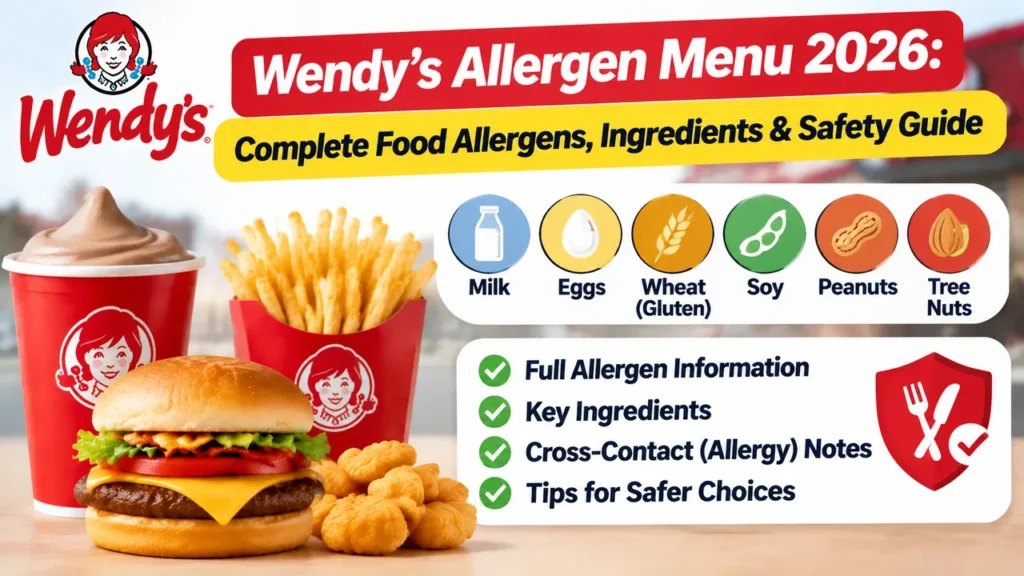
Yes. Wendy’s provides allergen information through its official website, mobile app, and restaurants. Its U.S. menu identifies nine major allergens: milk, eggs, fish, crustacean shellfish, tree nuts, peanuts, wheat, soybeans, and sesame.
Customers can review individual menu items and customize certain orders. However, Wendy’s warns that cross-contact is possible and does not guarantee that any menu item is completely free from allergens.
What Is Wendy’s Allergen Menu?
Wendy’s Allergen Menu is an information resource that helps customers identify known food allergens in the restaurant’s menu items.
It is designed to help people make more informed food choices by reviewing ingredients and allergen information before ordering.
Wendy’s provides this information through:
- Its official nutrition and allergen website.
- The Wendy’s mobile app.
- Participating restaurant locations.
- Individual menu item nutrition and allergen information.
According to Wendy’s, customers can customize many menu items to remove ingredients they are trying to avoid, including cheese and condiments. These changes can be requested online, through the app, or directly at a restaurant.
However, ingredient customization should not be confused with an allergen-free preparation guarantee. Shared utensils, equipment, preparation surfaces, and handling areas may introduce cross-contact.
Wendy’s Nine Major Food Allergens
The FDA recognizes nine major food allergens under U.S. federal food allergen law. Wendy’s identifies these nine allergens on its U.S. menu.
Here is what each allergen means and which menu ingredients customers should investigate.
1. Milk
Milk is a common ingredient in many restaurant products, including cheese, creamy sauces, and desserts.
When reviewing Wendy’s menu, pay particular attention to:
- Cheese and cheese toppings.
- Frosty desserts.
- Milk-based ingredients.
- Creamy sauces and dressings.
- Certain sandwich buns and bakery products.
2026 ingredient information: On February 25, 2026, Food Allergy Research & Education (FARE) published an ingredient notice stating that Wendy’s premium sandwich bun contains milk, sesame, and wheat.
The notice identified the bun for use on premium sandwiches, including hamburgers, the Breakfast Baconator, and classic and spicy chicken sandwiches.
Customers with milk allergies should check the current ingredients for the exact sandwich they intend to order.
2. Eggs
Eggs may appear in breakfast foods, mayonnaise-based condiments, sauces, and other prepared ingredients.
Check these ingredients when reviewing the menu:
- Breakfast sandwiches.
- Egg-based breakfast products.
- Mayonnaise.
- Certain dressings.
- Specialty sauces.
- Bakery products.
An order without mayonnaise is not automatically egg-free. Other ingredients and preparation equipment must also be considered.
3. Fish
Fish is an especially important allergen to investigate when ordering fried food.
In a March 6, 2026 ingredient notice, FARE reported that Wendy’s had identified potential fish cross-contact involving shared cooking and preparation equipment.
The notice specifically identified the following products as being cooked in a shared fryer with Wild Caught Alaskan Pollock fillets:
- French fries.
- Chicken nuggets.
- Spicy chicken nuggets.
- Chicken tenders.
- Classic chicken fillets.
- Spicy chicken fillets.
- Homestyle French Toast Sticks.
- Breakfast potatoes.
The notice also explained that some restaurants may serve the Crispy Panko Fish Sandwich year-round. Customers are encouraged to check the Wendy’s mobile app to determine whether fish is served year-round at their local restaurant.
Important: Do not assume that a fried product is safe for someone with a fish allergy simply because fish is not its main ingredient. Shared fryer exposure can create a cross-contact risk.
4. Crustacean Shellfish
Crustacean shellfish include:
- Shrimp.
- Crab.
- Lobster.
- Crayfish.
Customers with shellfish allergies should review the official ingredient and allergen information for their selected products.
Do not assume that an item is safe simply because it does not appear to contain seafood. Ask about ingredients and preparation practices when necessary.
5. Tree Nuts
Tree nuts include almonds, walnuts, cashews, pistachios, pecans, and other varieties.
When checking Wendy’s ingredients, pay particular attention to:
- Desserts.
- Bakery products.
- Specialty toppings.
- Limited-time products.
- Products carrying advisory allergen statements.
Tree nuts and peanuts are separate allergen categories. Someone with a peanut allergy should not automatically assume that a tree nut warning means the same thing, or vice versa.
6. Peanuts
Peanuts are a separate major food allergen under FDA regulations.
Customers with peanut allergies should examine ingredient information and ask about possible cross-contact.
Limited-time desserts and specialty products deserve particular attention because their toppings and ingredient combinations may differ from standard products.
For example, FARE’s February 19, 2026 notice concerning Wendy’s Thin Mints Frosty Fusion reported milk, soy, and wheat in Frosty Fusions, along with an advisory statement about possible traces of peanuts, almonds, and eggs for that limited-time offering.
That notice should not be interpreted as a permanent ingredient declaration for every Wendy’s dessert.
7. Wheat
Wheat is commonly used in bread, buns, bakery products, and breaded foods.
Potential ingredients to investigate include:
- Hamburger buns.
- Chicken sandwich buns.
- Breaded chicken.
- Biscuits.
- Croissants.
- Bakery products.
- Certain sauces and processed ingredients.
Wendy’s premium sandwich bun was specifically identified as containing wheat in FARE’s February 25, 2026 ingredient notice.
Customers with wheat allergies should check the complete ingredients of the bun, coating, sauce, and other components.
Wheat allergy and celiac disease are different conditions. Customers with celiac disease should also consider gluten and cross-contact, not simply the presence or absence of wheat as an allergen declaration.
8. Soybeans
Soy may be present in processed ingredients, sauces, seasonings, and other prepared foods.
When reviewing Wendy’s products, check:
- Sauces and condiments.
- Salad dressings.
- Bread and buns.
- Breaded products.
- Breakfast ingredients.
- Specialty desserts.
Do not assume that a product is soy-free based only on its main ingredients. Review the complete ingredient information.
9. Sesame
Sesame became the ninth major food allergen recognized under U.S. federal food allergen law on January 1, 2023, following the FASTER Act of 2021.
One particularly important Wendy’s update came on February 25, 2026, when FARE published a notice identifying sesame in Wendy’s premium sandwich bun.
The same notice identified milk and wheat in that bun.
Customers with sesame allergies should check the bun used in their selected sandwich and ask about preparation practices.
Wendy’s Allergen Reference Table
The following table is designed as a quick-reference guide. It explains the allergens customers should investigate and the menu components worth checking.
It is not a product-by-product allergen declaration. The presence of an allergen in a particular item must be verified using Wendy’s current official product information.
| Major allergen | Ingredients or menu components to check | Important consideration |
|---|---|---|
| Milk | Cheese, creamy sauces, Frosty, buns | Premium bun ingredient notice |
| Eggs | Breakfast items, mayonnaise, sauces | Check complete ingredients |
| Fish | Fried products and fish sandwich | Shared fryer notice |
| Crustacean shellfish | Ingredients and prepared products | Confirm current allergen details |
| Tree nuts | Desserts and specialty toppings | Check advisory statements |
| Peanuts | Desserts and specialty products | Check possible cross-contact |
| Wheat | Buns, breaded chicken, bakery items | Premium bun ingredient notice |
| Soybeans | Sauces, processed ingredients, desserts | Review complete ingredients |
| Sesame | Sandwich buns and other bread products | Premium bun ingredient notice |
How to use this table: Identify your specific allergen, review the exact product in Wendy’s official nutrition information, and ask the restaurant about preparation practices. Do not treat this reference table as a guarantee that any menu item is safe.
Wendy’s 2026 Ingredient and Allergen Updates
Food ingredients and supplier specifications can change. The following published notices are particularly relevant to customers reviewing Wendy’s allergen information in 2026.
February 19, 2026: Thin Mints Frosty Fusion
FARE published an ingredient notice concerning Wendy’s limited-time Thin Mints Frosty Fusion.
According to the notice:
- Frosty Fusions contain milk.
- Frosty Fusions contain soy.
- Frosty Fusions contain wheat.
- The limited-time offering carried an advisory statement about possible traces of peanuts, almonds, and eggs.
Customers should check the current product information rather than assume this limited-time offering is still available.
February 25, 2026: Premium Sandwich Bun
FARE reported that Wendy’s premium sandwich bun contains:
- Milk.
- Sesame.
- Wheat.
The notice identified the bun for premium sandwiches, including hamburgers, the Breakfast Baconator, classic and spicy chicken sandwiches, and the limited-time Crispy Panko Fish Sandwich.
This is an important ingredient update for customers avoiding any of these three allergens.
March 6, 2026: Fish and Shared Fryers
FARE published a fish allergen notice concerning Wendy’s Crispy Panko Fish Sandwich.
The notice identified potential cross-contact through shared handling and preparation areas and named several products cooked in a shared fryer with Wild Caught Alaskan Pollock fillets.
These included fries, nuggets, chicken fillets, French Toast Sticks, and breakfast potatoes.
It also advised customers to check the Wendy’s app to see whether their local restaurant serves the fish sandwich year-round.
These notices are dated 2026 announcements, not a guarantee that every restaurant has identical ingredients or preparation practices in November 2026. Always verify the latest information before ordering.
Allergens in Different Wendy’s Menu Categories
Different menu categories involve different ingredients and preparation methods. Reviewing the entire product, rather than just its main component, is important.
Wendy’s Burgers and Hamburgers
When ordering a Wendy’s burger, review:
- The hamburger bun.
- Cheese.
- Sauces and condiments.
- Seasonings.
- Additional toppings.
The premium sandwich bun notice is especially relevant to customers avoiding milk, sesame, or wheat.
Removing cheese or a condiment may change the ingredients in an order, but it does not guarantee that the finished product is free from allergen cross-contact.
Wendy’s Chicken Sandwiches and Nuggets
Chicken sandwiches and nuggets may contain ingredients in their coatings, buns, seasonings, and sauces that customers need to investigate.
Check:
- Breaded chicken coatings.
- Sandwich buns.
- Dipping sauces.
- Seasonings.
- Preparation equipment.
- Shared fryer practices.
The March 2026 fish notice is particularly important for customers with fish allergies.
Wendy’s Salads
Salads should not automatically be considered allergen-free because they contain vegetables.
Review:
- Cheese.
- Croutons.
- Salad dressings.
- Nuts and specialty toppings.
- Chicken ingredients.
- Preparation surfaces and utensils.
Removing one topping does not establish that the entire salad is free from the same allergen.
Wendy’s French Fries and Sides
Customers should investigate individual side items, including:
- French fries.
- Breakfast potatoes.
- Baked potatoes.
- Chili.
- Other available sides.
The shared fryer information in FARE’s March 2026 notice makes preparation practices particularly important for French fries and breakfast potatoes.
Do not assume that a side dish is safe just because its main ingredient does not contain your allergen.
Wendy’s Breakfast Menu
Breakfast products can involve several major allergens.
Items to review include:
- Breakfast sandwiches.
- Breakfast burritos.
- Biscuits.
- Croissants.
- French Toast Sticks.
- Breakfast potatoes.
Eggs, milk, wheat, sesame, and soy are especially relevant ingredients to investigate.
The premium sandwich bun notice also applies to the Breakfast Baconator.
Wendy’s Frosty and Desserts
Wendy’s Frosty products contain milk and cream, according to the company’s food quality information.
Customers with milk allergies should not assume that changing the flavor makes the dessert dairy-free.
Specialty desserts and limited-time additions may have additional ingredients and advisory allergen statements.
The February 2026 Thin Mints Frosty Fusion notice is an example of why limited-time desserts should be checked individually.
How to Check Wendy’s Allergen Menu Online in 2026
Checking the latest Wendy’s allergen information before ordering is straightforward.
Follow these steps:
Step 1: Visit Wendy’s official website.
Open the Wendy’s Nutrition & Food Allergens page.
Step 2: Open the menu.
Find the individual food item you are considering ordering.
Step 3: Select the Nutrition & Allergens information.
Review the ingredient and allergen details associated with the specific product.
Step 4: Check your customizations.
If you intend to remove cheese, mayonnaise, a bun, or another ingredient, review the available updated product information.
Step 5: Confirm the preparation process.
Contact the restaurant or speak with the crew before ordering. Ask about shared cooking equipment, utensils, preparation surfaces, and possible cross-contact.
Step 6: Recheck every time you order.
Recipes, suppliers, seasonal products, and restaurant preparation practices can change.
Wendy’s also explains that customers can access allergen information through its mobile app and restaurants.
Does Wendy’s Have Allergen-Free Food?
Wendy’s provides information about known allergens in its menu items, but it does not guarantee that any menu item is completely free from allergens.
The company specifically warns that cross-contact can occur because restaurants use common handling and preparation areas.
This distinction matters.
An ingredient list may identify what a food product contains, but it cannot necessarily establish what happened during every stage of restaurant preparation.
For customers with severe food allergies, an item that does not list a particular allergen should not automatically be considered safe.
Does Wendy’s Have a Gluten-Free Menu?
Wendy’s provides ingredient and allergen information, but customers should not interpret the absence of a wheat declaration as proof that an item is gluten-free.
Wheat allergy and celiac disease are different conditions.
People with celiac disease need to consider gluten-containing ingredients and possible cross-contact during preparation.
Before ordering, review the complete ingredients, coatings, sauces, and preparation methods.
If the restaurant cannot confirm the information needed to make a safe decision, do not assume the product is suitable.
Understanding Cross-Contact at Wendy’s
Cross-contact happens when an allergen is unintentionally transferred from one food or surface to another.
For example:
- A shared fryer may expose food to proteins from another product.
- A preparation surface may come into contact with allergen-containing ingredients.
- Shared utensils may transfer food residues.
- Gloves or handling equipment may introduce unwanted ingredients.
Cross-contact is different from an allergen being intentionally included in a recipe.
This is why reading the ingredients alone may not be enough for someone with a serious food allergy.
Wendy’s acknowledges this risk in its official allergen statement and says it cannot guarantee that menu items are completely free from allergens.
Tips for Ordering at Wendy’s With Food Allergies
If you have a diagnosed food allergy, take the following precautions before placing an order.
Clearly Explain Your Allergy
Tell the crew which specific allergen you need to avoid.
For example:
“I have a severe sesame allergy. Please help me check the ingredients and preparation process before I place my order.”
Clear communication helps the restaurant understand your concern.
Ask About Shared Equipment
Ask whether your selected food is prepared using shared fryers, grills, utensils, preparation surfaces, or other equipment.
This is particularly important when considering fried foods.
Do Not Rely Only on Ingredient Removal
Removing cheese, mayonnaise, a bun, or another topping does not automatically eliminate the risk of allergen cross-contact.
The remaining ingredients and preparation process must also be considered.
Check Limited-Time Products
New sauces, sandwiches, desserts, and seasonal products can have different ingredients from regular menu items.
Always check their current allergen information separately.
Follow Your Medical Allergy Plan
Follow the instructions provided by your healthcare professional.
If you have been prescribed epinephrine, keep it accessible and follow your emergency action plan.
Never rely on a restaurant allergen guide as a replacement for medical advice.
Frequently Asked Questions
Final Thoughts
The Wendy’s Allergen Menu 2026 is a useful resource for customers who want to understand the ingredients and known allergens associated with their food.
Before ordering a burger, chicken sandwich, salad, breakfast item, French fries, or Frosty, review the specific product rather than relying on assumptions about an entire menu category.
Pay particular attention to the 2026 ingredient notices concerning the premium sandwich bun, Thin Mints Frosty Fusion, and fish cross-contact in shared fryers.
Most importantly, remember that ingredient information and preparation safety are not the same thing. Wendy’s provides allergen information, but it does not guarantee that its food is completely free from cross-contact.
Check the latest information, communicate your dietary requirements clearly, and make an informed decision before ordering.
Food Allergy Disclaimer
We provide known instances of allergens; however, cross contact is possible due to common handling and preparation areas in our restaurants. We are unable to guarantee that any menu item can be completely free of allergens. Customers with allergies and sensitivities should exercise judgment when ordering. For more information on food allergies, you can review the Food Allergy Research & Education website at http://www.foodallergy.org.